
Here’s a fun and over the top project I recently did for Dungeons and Dragons (DnD).
One of the options for players is to be a Druid, which grants a “Wildshape” ability and allows you to turn into various animals for a limited time (The recent movie has the Druid character using this at every opportunity).
Since painting miniatures and going over the top is part of the fun of playing the game, I decided to see if I could make a complete set of all the animal forms available to the druid.
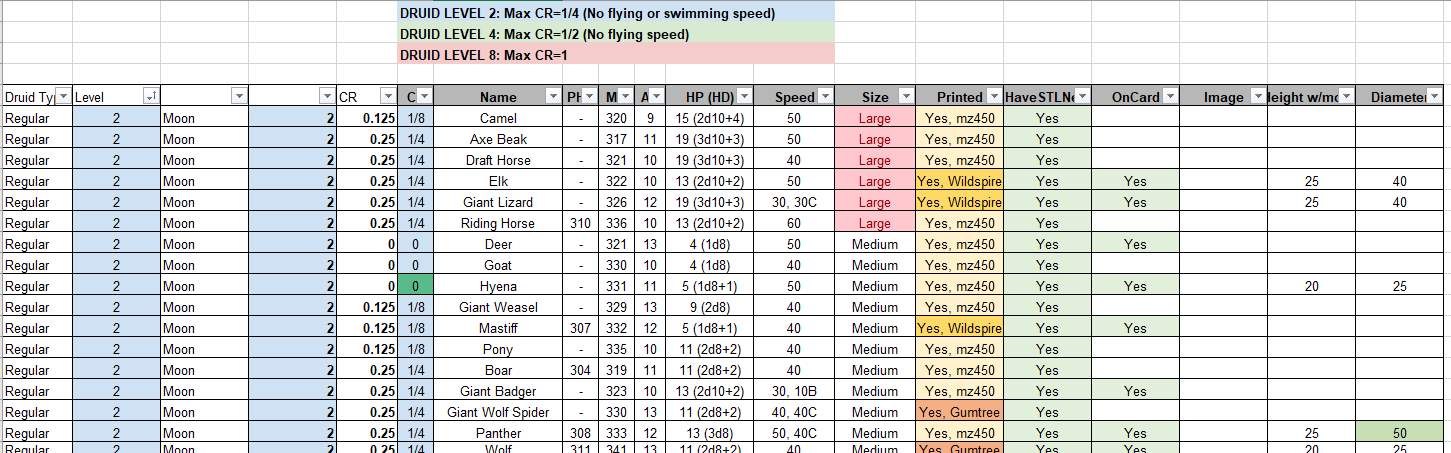
The first step was to get a list of beasts. I found this excellent spreadsheet by reddit user SpiralOut154:
https://www.reddit.com/r/DnD/comments/jd4718/druid_wild_shape_beast_list_updated/
With that as a starting point, I began checking off models that I had either already purchased, or printed:
My sources of models through this project were, in order:
- Gumtree (Craigslist Equivalent) –
With a bit of searching, you can often find people selling away their whole collections in one cheap lot. About a year ago I found someone who sold me around 300 miniatures, a ton of scenery, books, around 80+ paints & more for $400AUD.
2. Wildspire Minis
They have a wonderful selection of cheap, bulk minis available. I bought a couple of bulk sets to practice painting. As a newbie painter, it was a great help to be able to practice basic skills without worrying that I’d destroy a $20 mini. https://www.amazon.com/stores/WildspireMiniatures/page/B343BFEF-3714-440E-9750-50FC66D51848?ref_=ast_bln
3. The designer known as “mz4250” https://www.patreon.com/mz4250 and on shapeways & elsewhere.
I came to them late, but they were my best source of everything by far. Even when I already had a miniature from elsewhere, I found myself using their STLs as an aide to figure out, say, how much space a brown bear takes up.
Now that I had a full set of around 100 STL files, I realised that I had a couple of big challenges on my hands.
First challenge was how to keep the set organized when I’d finished. I want the collection:
- To be portable, so I can take it to the pub or wherever we’re playing. Should be robust against being carried on public transport, and lugged across the city.
- To exhibit what Adam Savage calls “first order retrievability”. No moving things to get to other things.
- To be visually obvious where everything goes, aka “Mise en place”
- If a stranger borrows a model, it should be easy to find and remove, and
- When returning it should be easy to spot where it should live.
- Likewise, I want to be able to tell at a glance if anything’s missing and I need to go search nearby tables for a figurine.
The second challenge was more about mental energy.
Printing can often be a frustrating process, so I wanted a way to feel that the collection was growing, and give me the motivation to keep on loading files and printing.
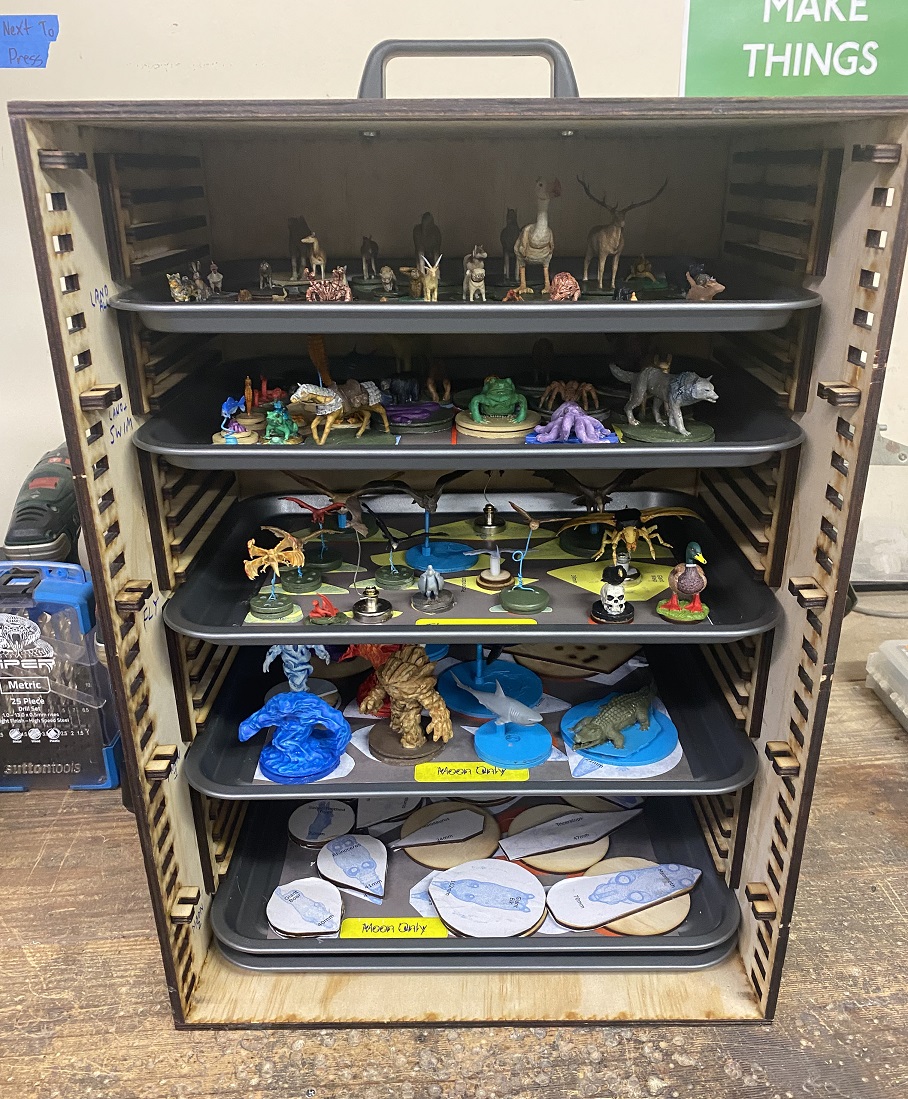
I decided to use metal trays in a lasercut box, and make a paper inlay to show what model goes where. (I already use magnets on all my models so they stay in place for storage). That way as each model is printed, you can see the space get taken up, and get that urge to complete the set and fill everything.
The question was how to make a picture of each model for the paper inlay. I didn’t fancy freehand sketching 100 different animals, and I also wanted to know the exact size of the models, and not just make a rectangular approximation.
Then I realised that the solution was already in the 3D STL models of each animal. I wrote some python code to open each file, look at the XYZ coordinates, then discard the Z (making the silhouette).
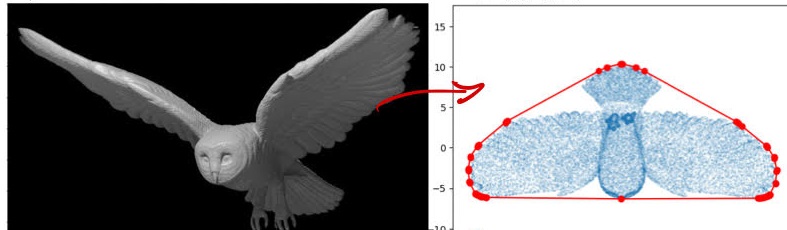
Plotting this gives the visual equivalent of an X-ray, or CT scan because, well, that’s kinda what it is doing.
My code printed this to an image as a bitmap, but more importantly it figured out the convex hull of all the XY coordinates, to determine the closed “footprint” of the object, and saved that as a vector shape in the same file.
I then exported them all to SVG files, and spent a while in inkscape rearranging the shapes across my different trays.
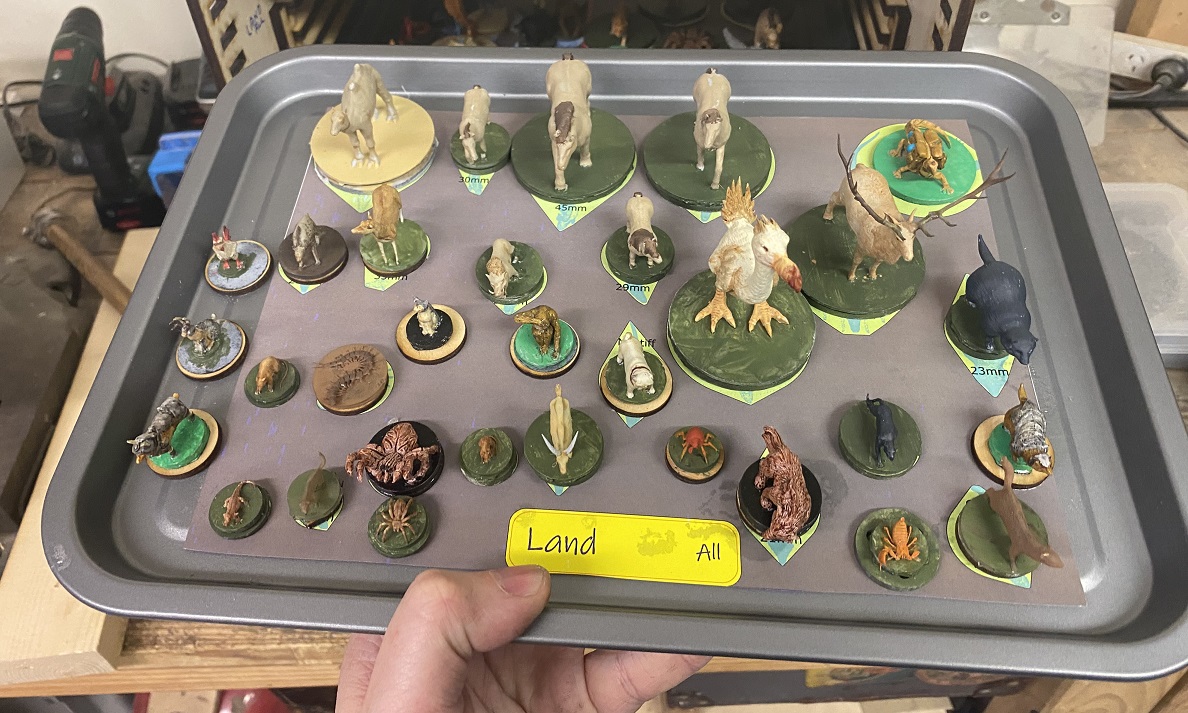
By making sure each paper inlay has a dark background, you can see at a glance which models are missing;
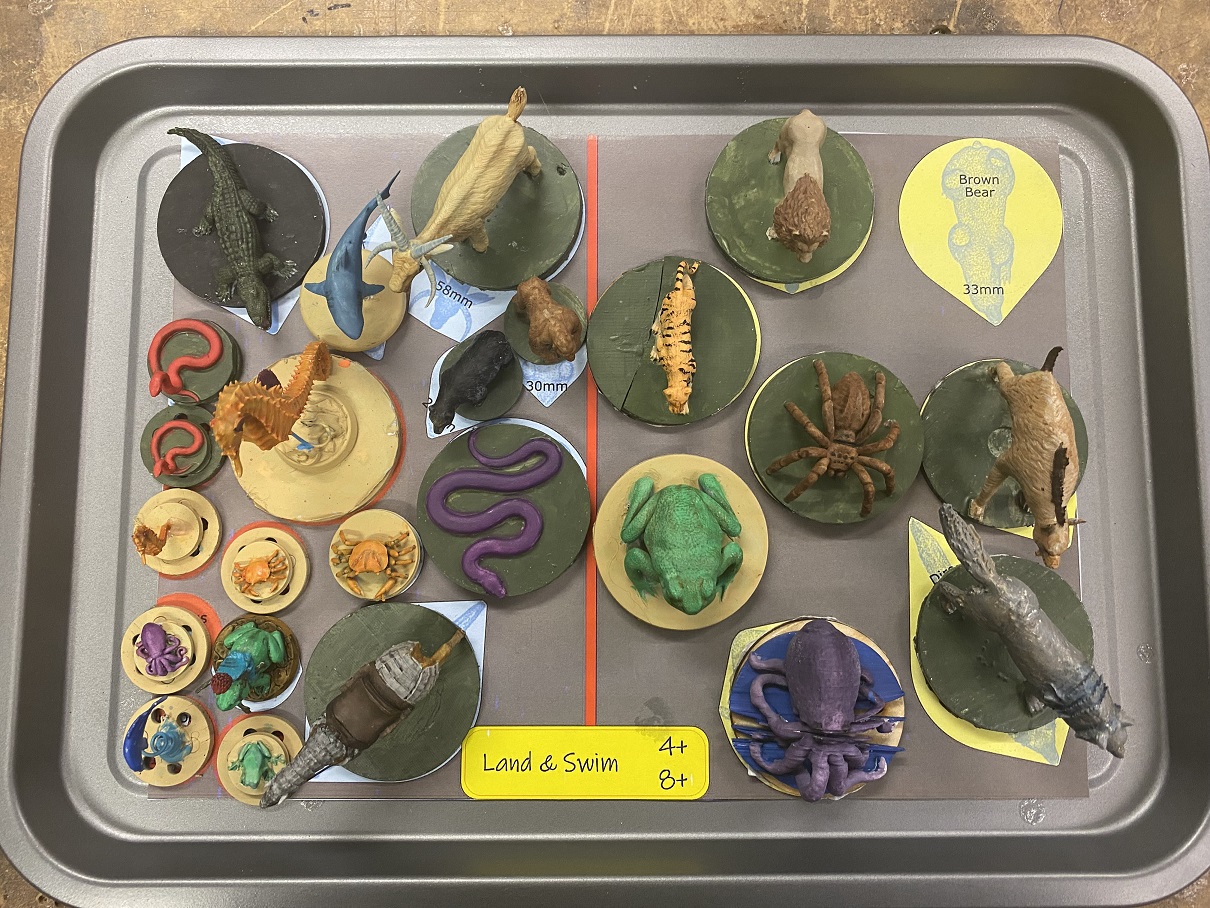
And the entire set fits in a lasercut plywood case for easy travel. An acrylic lid goes on the front to keep dust away and stop anything from getting lost. But the main beauty of this is the magnets that hold everything in place:
The robustness of the magnets can’t really be overstated:
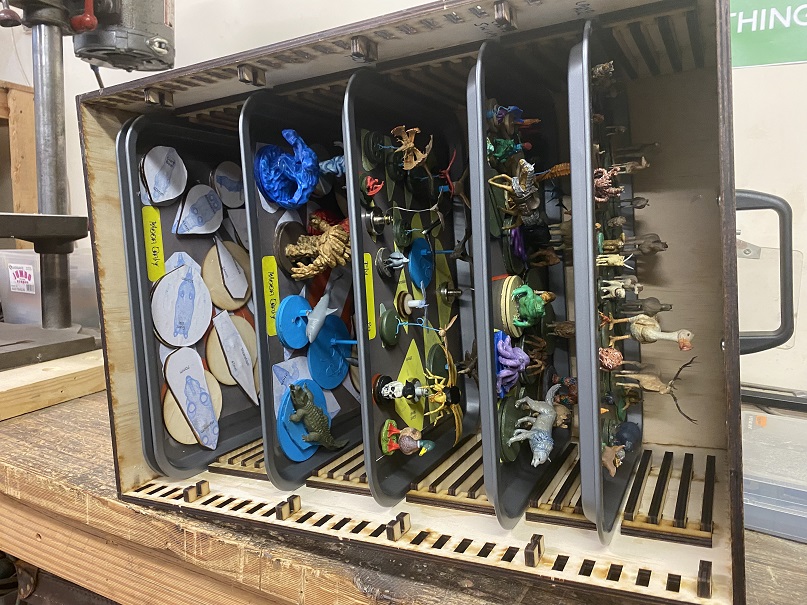
I still haven’t quite finished printing yet, but I’m getting close. It’s been a very fun project and gotten some good use at the pub.
Files are here for anyone that wants to make their own:


 Tinkerings